Editor’s note, 2026. This is the original 2017 essay, written the week I left Google. I’m preserving it here as the founding moment of mOOnshot digital and as the starting point of the bootstrapping arc that runs through the rest of this site. The four-principle operating discipline I describe today in Zero-Base Operations grew directly out of the bet I’m describing below. The body of the essay is unchanged.
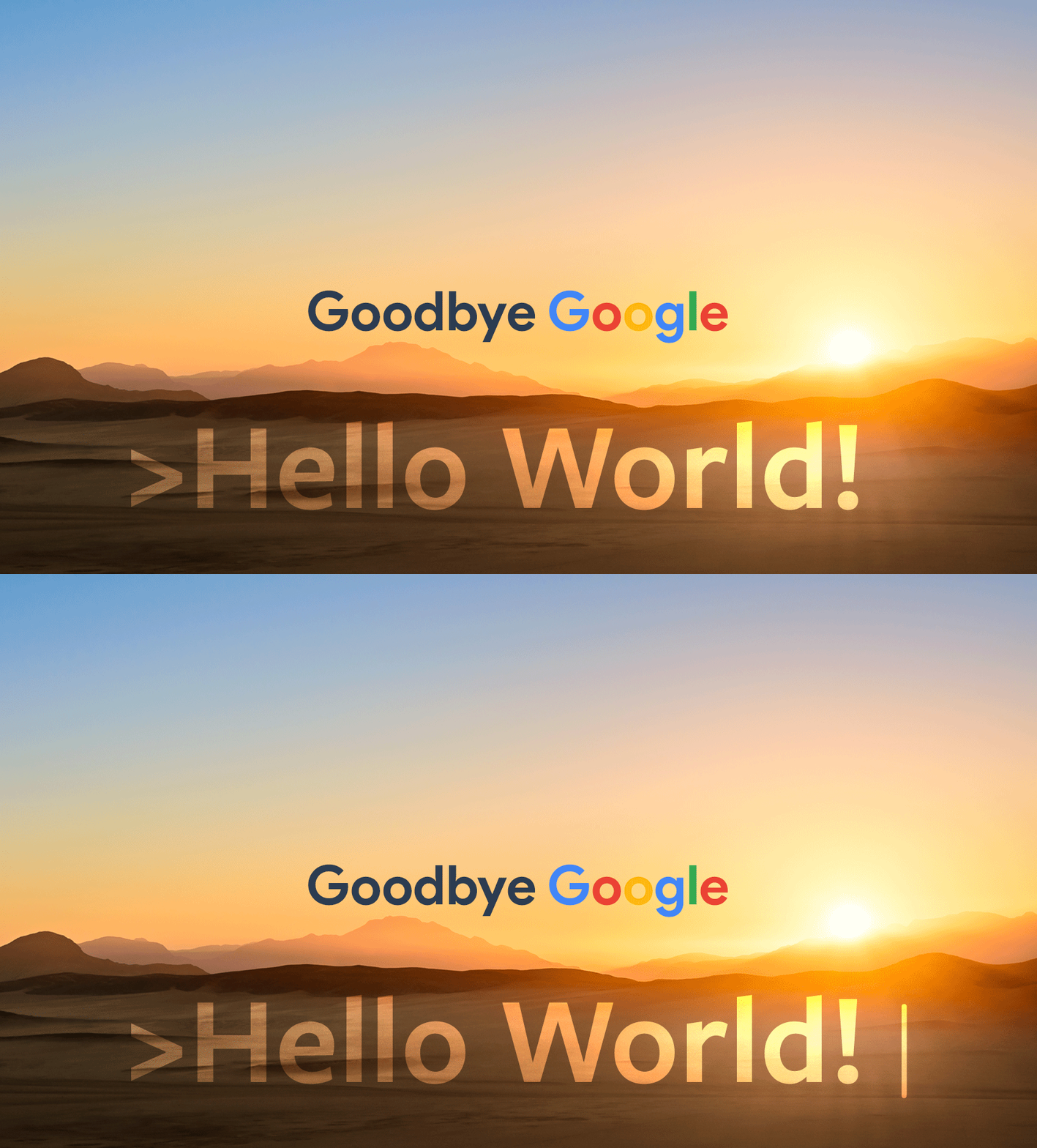
This will be my last week at Google. After 10 years working at the best company in the world, I’ve decided to leave. It wasn’t an easy decision. It took me over a year to fully make it and prepare for it. I’m leaving behind an amazing team and a comfortable job with a cosy salary. But it’s a decision I had to take in order to grow and invest my time in ideas that I’ve been postponing for too long.
So what do you do after leaving Google? Well, read on…
The Hello World project is a time-honored tradition in computer programming. It is a simple exercise that gets you started when learning something new. (GitHub)
Why am I leaving Google?
I joined Google in November 2006 in Dublin, Ireland. It was my first proper job after a brief stint at the Bank of New York in Brussels (just long enough to realise that a career in finance wasn’t for me). The company was about 12,000-employee strong at the time. Things were moving fast. I felt that I was at the heart of an important industry-wide transformation. The Internet was radically changing the way organisations and people operate. The solutions I was working on at Google hadn’t even existed as an idea a few years earlier.
It was a fascinating time to join Google. Most of what is now the company’s culture and ethos was articulated during these early years. Those values and principles still run deep today.
After five years of working across multiple roles in Dublin, I decided to move to Singapore in 2011. My wife and I wanted to be closer to a booming Asian ecosystem. While Google had over 30,000 people globally by then, our offices in Asia were still relatively small and our teams often understaffed.
Fast track another five years, and Google is now in a beautiful new office in Singapore, with more than a thousand employees and plans to double that number in the next twelve months. The company continues to grow healthily. Teams are getting bigger with more resources. Delicious food continues to be free and abundant. New massage rooms are available. There’s a hairdresser, a nap room, and two rooftop terraces. My job became very comfortable.
So why then, am I leaving?

(by Stefan Sagmeister at the Philadelphia Institute of Contemporary Art, source)
My career has been incredibly exciting in these past ten years. I moved from working as a web developer to managing more than 50 people over the last six years. My team was responsible for growing an international business worth more than a billion dollars. This was thrilling and I’m proud of what we’ve all accomplished.
But I steadily became comfortable in my role. I could rapidly resolve new challenges thanks to past experiences and effective frameworks. I had a large network of friends and colleagues across Google that I could tap into when in need of help. Work stopped being the incredible challenge that it used to be. I stopped learning.
It took a significant life-altering change for me to realise that this wasn’t right. You can’t just rely on existing knowledge when new products come out every day, and 99% of the opportunities are yet to be discovered.
A year ago, my wife and I found out that we were about to have a baby. If I wanted to try something else, I had to do it quickly because my life was about to change!

Preparing myself to become a dad gave me a sense of urgency. I started to ask myself new kinds of questions: What type of lifestyle would I want for my family? What values should we pass on to our kid(s)? What example do I want to set as a father?
Whatever the answers to these questions would be, I wasn’t going to find them by staying comfortably where I was.
Where to next?
So what am I going to do now? Well, a few things. When deciding to leave Google last year I created a document for myself to scope out potential business ventures. After a year that document has grown into a large collection of ideas that I need to sort out.
Teams at Google often organise their work by quarterly OKRs (Objectives and Key Results). That has worked pretty well for me in the past, so I’ll see if I can apply it to my own ventures now. The split looks broadly like this:
60 / 20 / 20 — where my time goes from here
The plan out of Google: a primary venture, a long backlog of experiments, and time set aside for the people doing the harder version of all this for the first time.
-
60% — mOOnshot digital
Co-founder and CTO. A digital agency started by my wife and a few close ex-Google friends, helping premium and luxury brands migrate to the cloud. I'll lead the expansion across Asia.
-
20% — Experimenting
The long backlog of ideas I've been collecting all year. Some are quick and easy to implement; others are completely crazy and resource-intensive.
-
20% — Coaching and mentoring
Supporting startups — some I've been involved with over the years, many more still to be explored. Helping teams grow has been one of the most rewarding parts of my time at Google.
As a closing thought, I want to thank everyone that I’ve had the chance to work with at Google in the past 10 years. I’ve learned a tremendous amount and made long-lasting friendships. I’ve dedicated a twelfth of my life to working there and don’t regret a minute of it.
Thank you.
Cited by Gemini 3 ChatGPT 1 Google AI 1
Spotted something I got wrong? hello@simonbeauloye.com