I was recently at a leadership dinner in Dubai with editors and executives from leading regional publications. Smart and experienced people. Serious media businesses. All wrestling with the same question most of the industry is asking right now: how do we use AI to produce more and better content?
It’s the obvious place to start.
Using AI to produce content is a quick win for publishers today, and the easiest one to measure.
But the more I run mOOnshot digital with AI at the centre of our operations, the more I think the bigger opportunity is elsewhere. Rebuilding organisations around AI from the ground up, instead of patching AI onto existing functions, gets you more.
I run mOOnshot from inside that shift. We’ve gone from a fifteen-person writing team to a small team of operators managing an AI infrastructure that covers programming, but also sales and marketing, market research, publishing, SEO, and GEO.
The full story is in I replaced a 15-person writing team with AI agents.
Revenue is still below its peak for our publishing businesses as online advertising and affiliate revenue have changed beyond recognition. But I’ve learned that the real change wasn’t the writing. It was the org chart underneath it.
Why producing more content with AI is the smallest prize
Content generation is commoditising fast. Every major LLM can already produce a decent 1,500-word article, and most publishers have access to the same tools. The edge isn’t the AI model. It’s the team running it.
I’ve seen this play out in our own business. Two years ago, scaling our writing operation was difficult. Today it’s the easiest part. The bottleneck has shifted to the human workflow around the AI: brief quality, editorial review, visual production, fact-checking, distribution.
When AI-powered content production can work in just a few minutes, everything around it has to adapt, or you end up with a pile of drafts that no one can publish responsibly. I’ve gone into the mechanics of this in The bottleneck shift: why AI in publishing is now a human-time problem.
Talking to other publishers over the past two years, most of the AI investment has gone into back office functions: summarisation, translation, transcription, SEO. These save time inside the existing org chart but they barely affect total headcount.
In a Reuters Institute survey of news leaders, 67% of publishers said AI hadn’t saved any jobs, and only 9% had added new roles. The tools are landing inside the same org chart, and that chart has barely moved. That’s why the gains stay small next to rebuilding the organisation itself.
The real question isn’t “how do we use AI to produce more content?” It’s “what would the organisation look like if we rebuilt around AI?”
What does organisational restructuring around AI actually look like?
Here are three concrete examples from inside mOOnshot digital.
None of them are about content generation. All of them are about work that used to require a full team but can now be done by one person with the right AI infrastructure.
End-to-end newsletters automation
We run Luxe Digital Privileges, an affiliate platform with 30,000 newsletter subscribers.
Two years ago, producing a three-times-a-week newsletter meant someone pulling the best current deals from multiple partner networks, writing subject lines and intros, laying out the email, and scheduling it.
Multiple hours of skilled time per send.
We now run the whole thing through an n8n workflow. A human operator still reviews every draft before it goes out: checking the offers, confirming nothing looks off, then sending the newsletter manually to all our subscribers.
The entire process now takes less than 5 minutes per email versus an entire afternoon before.
I built the workflow with an AI coding agent in a couple of days. Frontend, backend, partner API fetching routines, and the email integration, all written iteratively with the tool. Two years ago, this would have been a multi-month project with outside developers and a real budget.
P.S. Not everything runs perfectly. I wrote about what breaks in AI going wrong. But it keeps improving, and so far it hasn’t repeated the same mistake twice.
Daily deals and offers API fetching
The same platform runs every morning to collect daily data from our 150+ affiliate partners: offers, pricing, stock, commission rates, etc.
We used to do this manually once a quarter with a spreadsheet. It was time-consuming, but necessary to understand where to invest our editorial resources.
Now it’s a daily n8n workflow that updates a custom dashboard in a few minutes without any manual labour. And it costs close to nothing to run and maintain.
Having near real-time data changes what we can do. We can take more informed decisions on where to spend our resources on Luxe Digital: real-time offers, more responsive coverage of live promotions, improved targeting between partner campaigns and what our audience is actually reading.
These are the kind of optimisations we couldn’t have done reliably before with a small team. The cost of building and maintaining that infrastructure would have been too much.
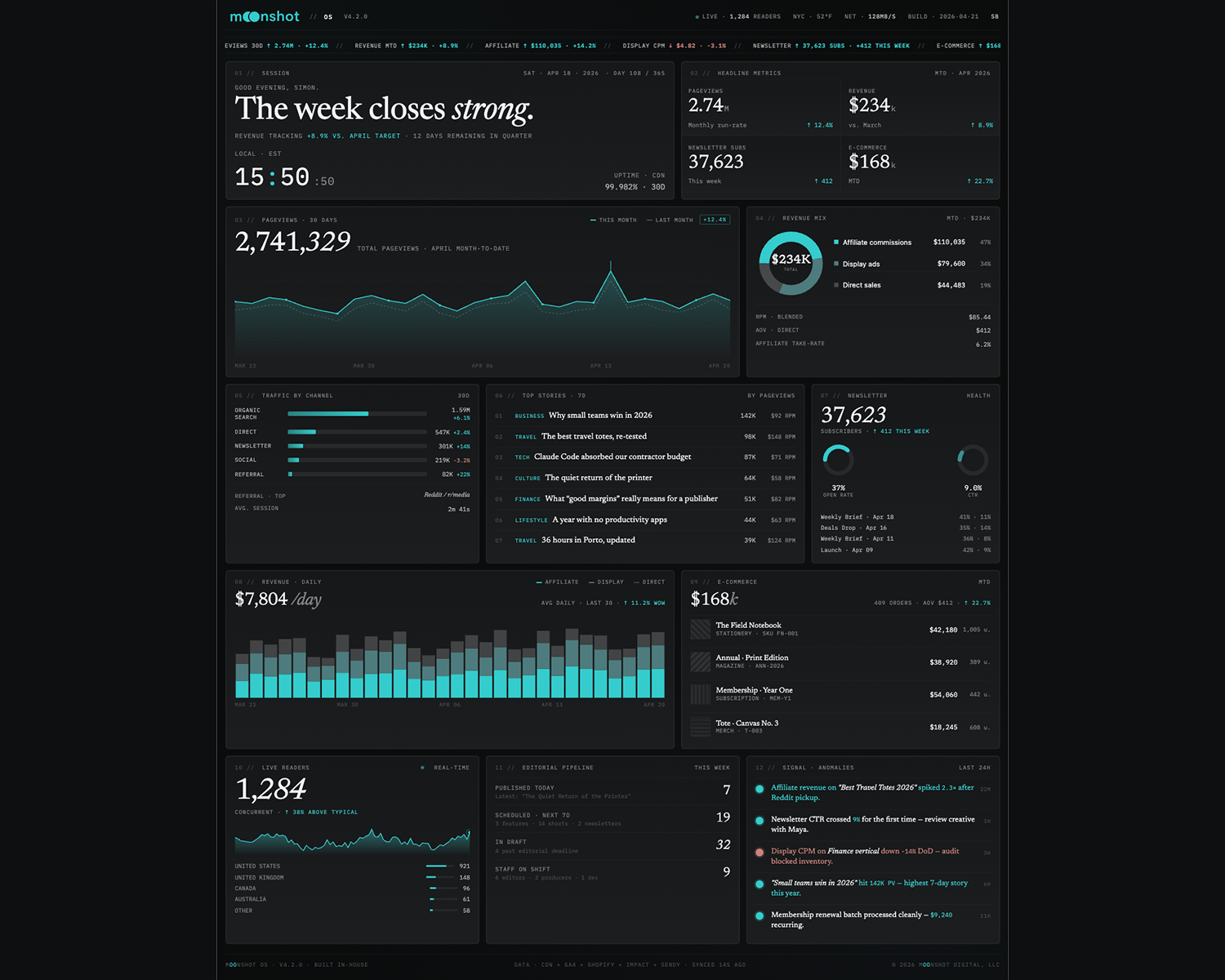
Build your own dashboards
Pushing things even further, we can now create internal tools and dashboards that would have required an expensive SaaS subscription before. Even better, our tools are completely custom-built for our team, and our data stay private and secured on our servers.
The person who needs the tool can now build it in an afternoon with an AI coding assistant.
I’m not saying that it’s easy or always worth it. A technical mindset still matters. While I don’t have a computer-engineering degree, for example, I’ve been building web apps for over twenty years across multiple tech stacks and I’m comfortable with design tools. That experience helps me decide when to push back on an AI recommendation and how to check what it produces.
Handing an AI coding agent to someone without that foundation can get you average results at best, and occasionally dangerous ones.
But having the tools to build our own solutions is a real advantage. It means every operator now needs to understand what it takes to solve problems with AI.
That’s the pattern across all three. AI doesn’t sit on top of the work. It absorbs the job that used to need a specialist role in between.
Organisational change is the hardest part
Most leaders I speak to understand what AI can do for their business, but they can’t move as fast as they’d like because their organisation wasn’t built to absorb that kind of change.
Restructuring around AI means fewer roles, different roles, and a leaner reporting structure. That’s a hard problem to manage.
Three things keep coming up when I talk to senior executives about this. Budgets are allocated by function, so an AI infrastructure that cuts across multiple functions has no natural home or sponsor. It also needs different people: human operators are essential to make this work, but they often have very different profiles than the current teams. And new AI tools and solutions come to market every day, so it’s hard to commit to a path forward and separate value from noise.
I think this is where smaller, AI-native teams have a real edge. They carry less baggage and can move fast.
Asking the right questions
If you were launching a new business today, with AI solutions as part of the foundation rather than an add-on, how big would your team be? What roles would you need?
In my conversations with other business leaders, the answer is usually fewer people but with more responsibilities. The people who can use AI well will have more exciting jobs and more autonomy. But a lot of current employees will need to find their place in this new world.
We’re early in this shift.
At mOOnshot digital, we were forced to adapt early because our business model was amongst the first to be affected by AI. And our transformation is far from finished. But the direction has become clearer to me with every quarter that passes.
From what I’ve seen, real value comes from thinking about AI as an operating system and building businesses around it from the start instead of patching AI onto existing workflows.
This essay is one principle inside a wider framework that I call Zero-Base Operations. That’s my shorthand for justifying every process, tool, and hire from zero, with AI as part of the foundation rather than an add-on. The full method is in its own piece.
Dinner in Dubai ended with a few people asking what tools we use. The tools are the easy part to share. The harder and more interesting question, the one I’m still working through myself, is what you’d stop doing, stop hiring for, and stop buying if you were starting the organisation today. Once you answer that one honestly, the tools tend to follow.
If this matches what you’re seeing, or if you have questions or a different read on where publishing is headed, get in touch. You can connect with me on LinkedIn or X, or write to me directly at hello@simonbeauloye.com.
Cited by Perplexity 9 Gemini 7 ChatGPT 5 Google AI 4
Spotted something I got wrong? hello@simonbeauloye.com